Valentine Goa Package

What better place to celebrate Valentine’s Day than in a cozy Heritage Homestay in Goa’s Latin Quarter of Fontainhas ? 

Each Heritage Suite has a separate living room, bedroom, bathroom and balcony or sit out. It also has nice colonial-style furniture & a certain olde world romantic charm.

  • Complimentary Champagne Breakfast 
  • Complimentary Bottle of Goan Wine 
  • Complimentary Tickets to a Romantic Movie
  • Complimentary Valentine’s Day Surprise on Arrival
  • Complimentary Late Check Out till 5 pm, subject to availability
  • Complimentary selection of daily Goan Newspapers
  • Complimentary bottled Mineral Water throughout your stay
  • Complimentary Hand made Bath Amenities

4 days 3 nights Valentine Goa Package in a Romantic Suite: Rs. 19,000

Please make your reservations well in advance since we are a small Homestay and are often booked out quite early.

India: +91 94480 87708
Europe: +43 680 2303682

mihirnayak@outlook.com

← Back

Thank you for your response. ✨

Christmas in Goa

My mother Dr Laura Nayak blogs from Goa:

In the past 27 years I have always spent Christmas in Bangalore with family and friends apart from once or twice in Delhi or Mumbai. But this time, with our son’s Hotel in Goa, my husband and I decided to experience Christmas in Goa like true Goans.

We reached here on18th December to a really chilly morning (most unlike our earlier Goan experiences where the weather was hot and sunny) On the 19th of December, Goa celebrated 50 years of Goan Liberation. We spent the day reading the whole story of Goan Liberation in different papers and then watching all the schools in the neighbourhood take out parades with drums and slogans in different directions. The Government of Goa also organised several programmes, among them the honouring of the famous architect Charles Correa – the world renowned son of the soil whose fame has spread far beyond the shores of his native state of Goa. Following which, there were several musical events and speeches.

Slowly the city of Panjim is getting dressed up for Christmas – the old heritage houses and hotels are painstakingly decorated with stars, Christmas trees and colourful lanterns. Lots of Santas and people singing carols in the church square.

When I was young, we youngsters used to go carol singing in Delhi from one Christian/Catholic house to another and to the Embassies as well. We were always offered plum cake, “kuswar” (a traditional Goan/Mangalorean sweet), sweet wine and given money which went for a charitable cause – Our reward was a lovely picnic after New Year.

In Goa, they have a different tradition. People of all ages dressed in Santa caps and stoles and carrying colourful lanterns walk the streets singing christmas carols to spread Christmas Cheer in the neighbourhood of Fontainhas, for both Christians and Non Christians alike. They warmly welcomed me to the group and I must say I really enjoyed reliving my childhood experience.

Most Christian households in Goa are busy making “kuswar” (with some just buying from the nearest bakery) and cakes, putting up the crib and Christmas trees. Apart from the regular stores selling Christmas decorations, several makesift ones have come up across the neighbourhood of Fontainhas. Stars of different sizes and colours have come up. And of course everyone is making the rich plum cake and different wines to share with friends and family. One old neighbour even asked me whether I’ve got my new dress ready!!!

Tomorrow we get ready for the open – air midnight mass, in front of the Church singing lots of christmas carols (the choirs have been practising seriously for the past few days) and after greeting each other come home for cake and wine.

Then to get up on Christmas Day and enjoy the festive feeling, exchange sweets with neighbours and friends and settle down to a hearty Christmas lunch.

Merry Christmas to All!

Houses of Goa Museum, Bardez, Goa

Goa has enjoyed a unique history as a result of both Western and Eastern influences. This unique history is especially visible in the architecture and layout of Goan Homes.

“When the Portuguese colonized Goa,” the famous Goan architect Gerald da Cunha says, “they brought in their own architectural designs and lifestyle to influence the already strong culture and architecture that prevailed here. As a result of the amalgamation, an entirely new thing emerged. What you see in Goan houses, you don’t see in Portugal, or elsewhere in the world.”

The Houses of Goa is a unique museum by Gerard da Cunha and a must see for all students and fans of unique Goan architecture from the American Ambassador and his wife to local couples who come to discover their Goan heritage. As an architect and a Goan, da Cunha felt that it was his responsibility to document the architecture as a local.

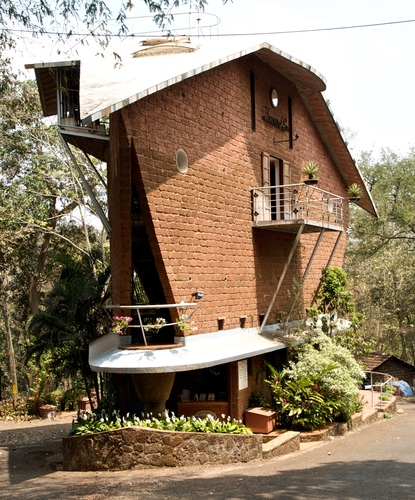
The result is a rather strange ship like structure with exposed brick that houses this museum, located kind of right in the middle of the road !

On the first floor, you have a depiction of Goa in the context of the world as well as wealth of Goan architecture.

On the second floor, Gerard da Cunha delves into the details of Goan architecture with a painstaking collection of doors, windows, a rare hat stand, old French doors from a house in Margao built in 1917 as well as rare postcards of Goa dating back to 1900, giving an exclusive picture of what Goa and its cities looked like a century ago.The panels on the walls showing important Goan monuments such as the Se Cathedral as well as other world monuments that were built at the same time in other parts of the world.

Climb the winding steps to the theatre upstairs and you can see a slide show presentation, with an adaptable screen, conducted by Da Cunha himself and taking you on an architectural tour back to the earliest mud house.

What I personally liked best about the Museum is the fact that it never seems finished, always a work in progress. The many trinkets, paintings and architectural accessoires seem to be in a permanent state of influx. I guess, what I am trying to say is that it is as if the Museum is constantly changing, evolving, like a living being. 

“Goans, who were people who were converted, were looking for a new identity, and thus embarked on the experiment in architecture, to produce something unique and unseen anywhere in the world”. 

Da Cunha’s landmark museum provides a ringside view!

Stay Romantic!

Mihir

Only a 5 km drive from my Mitaroy Goa Hotel, the Houses of Goa Museum is located in Torda, Salvador-do-Mundo village of Bardez taluk in North Goa.

Please note that the Houses of Goa Museum is open from 10 AM to 7.30 PM and closed on Mondays!


Braganca House in Chandor, Goa – Goa’s Heritage

In the centre of the small, sleepy village of Chandor in south Goa lies a 450 year old sprawling Portuguese mansion named Braganca House. Built in the 16th century by the two Braganca brothers, they divided the large mansion into two parts where the brothers lived with their families. The west wing became the property of the Menezies Bragancas and the east wing of the Pereira Bragancas.

For anyone looking for a peek into the lives of the landed gentry of the Portuguese era, the Braganca House is probably your best bet. From the ceiling tiles hand-painted by Chinese artists, to the oyster shell windows and the exquisite porcelain plates from Macau adorning the walls.

One of the first things that struck me about the interiors was the handcrafted furniture in rose & teakwood. Over 2 centuries ago, Goan carpenters who would come to Braganca House daily to carve, chip and chistle. Their handcrafted work includes intricately carved four-poster beds adorned with the family’s initials and dining chairs that are the exact replica of those, which are now used by Queen Elizabeth in the Buckingham Palace !

While you are in the West Wing of the Braganca House, don’t miss what is widely regarded as the single largest private library in the whole of Goa. 5000 (!!!) books sit on rows and rows of book shelves running alongside the walls. There are Portuguese, English, French and Latin tomes. Shakespeare and Tolstoy sit side by side with the great Classics of Portuguese literature. It is like having the world’s authors next to each other in a single room.

The entire Braganca House has an eerie sense of the melancholic. I later learn that it was in 1962, a year after Goa’s liberation, that the landed Braganca family lost all their lands in the new Goan land reforms. With no compensation from the government, the Braganca family was forced to open the legacy of the Braganca House to the public. Under the contemptuous gaze of the solemn looking ancestral portraits, one gets the feeling that this is not a decision that the Braganca ancestors are completely in agreement with. But then again, maybe it’s just the lack of air that causes my thoughts to wander…

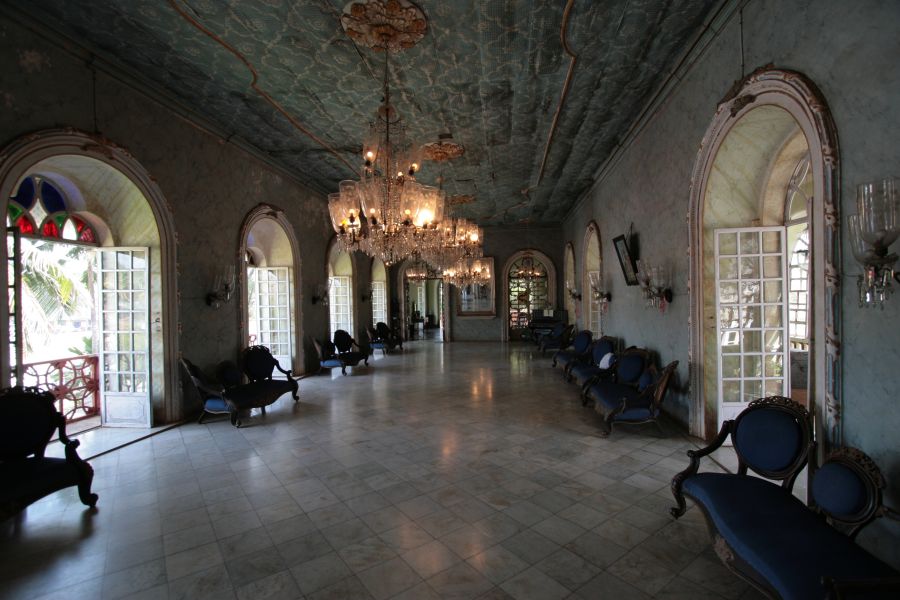
In the East end of the Braganca House, the age of the house and the ravages of time are more apparent. In the ballroom, with its Italian alabaster marble flooring and crystal chandeliers from Venice, the ceiling is damp and peeling in large chunks. But it only requires a little bit of imagination to take me back to the days when the aristocracy of old Portuguese Goa glided elegantly across the marble floor.

Today, the Braganca House serves more as a storage space for old family relics than as a memoir to the Old Portuguese way of life. In the corridor, sit a pair of ancient tombstones belonging to the Braganca ancestors. Dating back to the 1800s, they were suffering damage in the open graveyard and are now protected indoors. In the corridor also lies a palanquin, that was used by the Braganca ancestors as a common mode of transport. The family chapel also houses what is believed to be a single fingernail of the Jesuit saint and patron saint of Goa, St Francis Xavier.

The atmosphere of the Braganca House is one of saudade, the Portuguese word for a feeling of longing for something dear that is now gone. Braganca House represents the last of Goa’s golden era of prosperity.

Perhaps, some day Braganca House will come to represent the future of Goa, where tourist and locals alike will be drawn toward the heritage of Old Portuguese Goa once again…

While there is no charge for visiting the Braganca House, a donation of Rs 100 is a welcome contribution towards it’s upkeep.

Stay Romantic!

Mihir