Musings of a Journalist

A 4 Suite Hotel only for Couples, the Mitaroy Goa Hotel is located in the UNESCO Heritage Zone of Fontainhas. Fontainhas is quietly tucked away from all the hustle and bustle of Panjim, yet is only a few minutes walk to the Panjim Jetty. Known as Asia’s only Latin Quarter, Fontainhas is quaint, quiet and pollution-free – an idyllic bastion of the old Portuguese times.

The property itself is an over 200-year-old Portuguese Bungalow, carefully restored by one of India’s most respected architects who has created a happy blend of the old and the new – an inviting water-body at the entrance, terra-cotta floor-tiles, typical white walls, exposed laterite stone walls, wooden staircase, large French windows, old doors, a relaxing red-oxide balcao to while away the time of the day.

The Suites are spacious near 1000 sq feet with a lounge, bedroom, bath and balcony or garden area. Antique furniture, airconditioning, modern toilets, hand made toiletries, crisp bed-linen and caring service blend seamlessly to offer the discerning guest a memorable stay.

Couples staying at the Mitaroy Goa Hotel experience life in the slow lane – cats stretched out lazily on window-sills, fisher-women doing her rounds, replete in her marathi-style sari, bakers with their hot Goan “pav” breads tooting along on their cycle. Fontainhas is seemingly an idyllic “vaddo” (village) but just a stone’s throw from city-centre. A walk through the narrow lanes and quaint bye-lanes of Fontainhas makes for quite an unforgettable romantic experience.

In congruence with the leisurely lifestyle of the Goans, breakfast is served at a time of your choice (none of the hustle and bustle of a typical hotel buffet). Bacon, salami, boiled-eggs, fresh fruit & fruit-juice, Goan pav bread, aloo bhaji, butter, natural fruit jam, marmalade, cheese and freshly brewed coffe or tea.

Lunch and dinner are not served at the Mitaroy Goa Hotel. Instead, guests are encouraged to wander and visit the typical local Goan restaurants and sample the local fare – typical Goan cuisine at Linda’s, fusion cuisine at Venite (Latin for “Oh Come” ) or a typical Portuguese food at the Horseshoe restaurant – that is in abundance in and around Fontainhas. For entertainment, the local hotspot “Down The Road” or the casinos with their jettys just a 5 minute walk away beckon the daring. A boat cruise at sundown on the Mandovi River, a romantic movie at the Inox multiplex cinema or window shopping at the swank, new Caculo Mall nearby are pleasant ways to while away your time.

Jack, your natty caretaker & guide will be happy to assist with any longer journeys you may wish to make to the beach, Old Goa, Mangueshi Temple or the famous bird sanctuary in Diwar. He might even take you for a walkabout in the Fontainhas area, known for its heritage walk circuit.

Innumerable options to keep you busy on the 4 Day 3 Night Romantic Package with late check out option if you so wish comes with a price tag of Euros 100 per night.

For more information and pictures, check out their website at http://www.mitaroygoahotel.com or mail them at mitaroygroup@gmail.com (call 0-9448087708). For those living in Europe, Mihir Nayak, the young Austria-based owner is available at mihhirnayak@gmail.com (call 0043-6802303682).
Viva Panjim Restaurant Goa

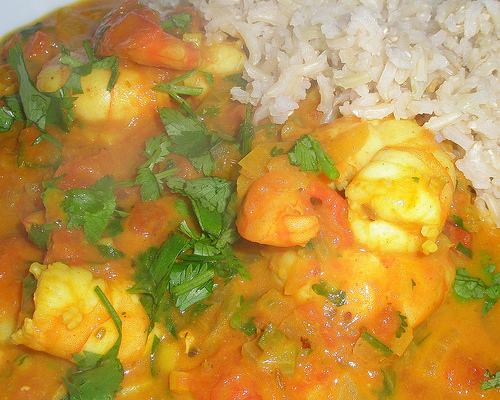
Just a 5 minute stroll away from my Mitaroy Goa Hotel in the neighbourhood of Fontainhas is a small restaurant that serves the best prawn curry rice I have ever eaten.

Panjim, the capital of Goa, is known for its amazing restaurants. I know people who stay in North Goa but still come to Panjim every day to try out the restaurants here.

Viva Panjim, located in a Heritage Home in the UNESCO Heritage Zone of Fontainhas in Panjim, is a real treat for sea food lovers. Popularized by the Lonely Planet Guide and the Rough Guide, you can see foreign tourists making a beeline towards the restaurant which is tucked away in a quiet, side street.

Whenever we eat at Viva Panjim, we prefer to sit outside on the portico rather than inside this heritage house. A Goan feni with lime is a great way to start off the meal, with a side order of fried mussels. I then move on to my favourite prawn curry rice accompanied by another round of Goan feni with lime.

The consistency of the prawn curry is just right – not too thick and not too watery. The ingredients in the prawn curry rice are secret but the result is a unique, orangish hue. The portion is really large with a good serving of rice and atleast 6 huge prawns.

The Owner of Viva Panjim and a family friend of ours, Linda sits at her desk every day and keeps a sharp eye on the waiters to see if they are doing their job. Linda’s stern face breaks into a smile when a new guest walks in. She knows most customers who are either old friends or loyal guests and she greets them by name. 

Most first time guests swear by Viva Panjim and quite often, you see familiar faces of guests who religiously visit Viva Panjim for at least one meal every day.

Once we polish off the last of the rice and prawn curry and wash it down with a last Goan feni with lime, it is time to slowly make our way back to our private Suite at my Mitaroy Goa Hotel and partake of a very welcome afternoon Siesta!

Stay Romantic!

Mihir

About Us

My name is Mihir Ignatius Nayak and this is the story of how I started the Mitaroy Goa. 

From a very young age (I think I must have been 2 or 3 years old), my parents used to take me on a number of holidays across India. My father was one of India’s first travel journalists and he got to stay at many hotels as part of his work. My mother, who had a really stressful job as a Doctor, loved to travel.

My earliest recollections as a small boy, were packing our stuff, getting into our small car and driving away to some new, exciting place. And when my little sister was born, we used to bundle her into the car too, nappies and all!

When I started school, we used to go every summer for a week’s holiday to Goa. Delicious Goan food, miles of untouched beaches and the knowledge that school was a full 2 months away meant that I looked forward to the summer holidays the whole year round. For me, the summer holidays were undoubtedly the best time of my childhood.

It was then at the tender age of 10 that I had a dream. One day I would open my own hotel in Goa and it would be called “Mitaroy”.  

When I told my mother about my dream to open my own hotel someday, she must have smiled to herself, wondering how I could ever dream of owning my own hotel.

When I finished high school, my parents wanted me to study law like my grandfather. But I was determined to study hotel management and pursue my childhood dream. After looking at a number of hotel schools in the UK, Switzerland, Australia and Austria, I finally decided on the Salzburg Tourism School in Austria, where many famous hoteliers from across the globe had studied.

5 years later, I graduated with excellent grades, topping my class, even though all the subjects were in German! From making beds and polishing cutlery to checking in dignitaries and cooking with a Michelin chef, I worked my way from small bed & breakfasts to Grand Hotels. But I never forgot my boyhood dream of opening my own hotel some day.

When I returned to India, I was looking to start out on my own. My parents owned an old house in our ancestral neighbourhood of Fontainhas. They didn’t know what to do with it and it was lying in a dilapidated condition. I decided that I would take up the job of restoring the old house and convert it into a hotel.

And 15 years later, I actually did open my first hotel, thus making boyhood dream a reality.

In the future, I plan to open hotels in Salzburg, London, Berlin and Cape Town.

But whatever the future might hold for me, I have learnt that if you dare to dream and believe in yourself, all your dreams will come true…

Dr Salim Ali Bird Sanctuary, Goa

Goa’s only bird sanctuary, the Dr Salim Ali Bird Sanctuary in Goa is named after the famous Indian ornithologist Dr Salim Ali.

On the western tip of Chorao Island along the River Mandovi, mangrove swamps that cover this bird-watchers’ paradise provide refuge and sanctuary to a wide variety of local and migratory birds on the island. Apart from a rich variety of coastal birds, you can even see flying foxes, jackals and the razor sharp teeth of the odd crocodile as he simply sits there, lazing in the sun with his mouth open.

The Mangrove eco system on Chorao Island also has another very important role to play. The Mangrove eco system also provides the ideal breeding grounds for several varieties of fish and insects which form part of the food chain for these rare species of birds.

The Sanctuary is criss-crossed with a network of water channels. Thus, if you travel by boat, you can only visit during high tide. During low tide, the creeks are only accessible by canoe.

A watch-tower has also been erected in the Sanctuary for better viewing of the birds. Apart from the several resident birds, the Sanctuary also plays host to winter visitors such as coots and pintails.

The scenic and serene atmosphere of the Sanctuary make it a highly rejuvenating place for couples to unwind, reconnect and fall in love again.

Stay Romantic!

Mihir

The Ribandar Ferry Wharf is only a short ride from my Mitaroy Goa Hotel in Panjim. From the Ribandar ferry wharf, you take the ferry across the Mandovi river to the island of Chorao. The Dr. Salim Ali Bird Sanctuary is then a short walk from the ferry wharf on Chorao Island.

Open throughout the year, the Salim Ali Bird Sanctuary can only be visited with the permission of the Chief Wildlife Warden.

Museum of Christian Art, Old Goa

Tucked away in a quiet road near the majestic Basilica of Bom Jesus is Asia’s first and only Museum of Christian Art.

Inaugurated in 1994 by the then President of India, Shri Shankar Dayal Sharma, the museum, which has enriched the cultural heritage and history of Goa was originally set up at the Seminary of Rachol in Salcette, Goa.

However, for the convenience of the general public and tourist visitors to Goa and with the support of the Archdiocese of Goa, the Museum of Christian Art was relocated to within the precinct of the Convent of Santa Monica, Old Goa, in the vicinity of the World Heritage Monuments. Most tourists only visit the World Heritage Monuments, leaving the few tourists that trickle in to the Museum of Christian Art enough space and time to look around.

I join a few tourists who have managed to make it past the World Heritage Monuments and are walking slowly, almost solemnly, toward the Museum of Christian Art. Before we get there however, we pass by the Convent of Santa Monica.

Th Convent of Santa Monica, built in the year 1627, has considerable architectural and historical significance. The Convent was at one time extremely important on account of royal patronage and was known as the Royal Monastery. I dislodge myself from the group and take a look inside. Past a few scaffoldings, I enter a large Church which is in the process of being restored. As I look around, I come upon an old cross hanging in the centre of the Church. I read a faded inscription next to the cross stating that sometime in the 17th century (I forget the date), this cross actually wept blood. Millions of pilgrims came from all across Goa and South India to witness this miracle. Now the cross hangs forlorn and forgotten in an old Church. 

The Museum of Christian Art in Old Goa itself forms the other half of the Church. Thanks to an entrance fee and efforts by the Archdiocese of Goa and the Goa Government, the Museum of Christian Art is much better preserved than the old Church.

The Museum of Christian Art houses a number of beautiful old paintings, sculptures and statues dating back to the early reign of the Portuguese in Goa. However, the Museum of Christian Art is unique in the fact that it houses a selection of objects on display that are the Hindu contribution to Christian Art in Goa and India.

Before visiting the museum, I wasn’t aware that many Hindu artists and artisans were involved in the building and creating of Christian artifacts during the Portuguese colonial rule.

At the time, images and paintings could not be dispatched from Portugal fast enough to meet the rising demand in an increasingly developed Goa. Hence, the Portuguese authorities were forced to use local Hindu artists and artisans to complete this religious work. The permanent requirements of producing images of the myriad of Hindu deities coupled with the existence of hundreds of Hindu temples and shrines in Goa was the shining proof of a well established and highly respected Goan School of Art.

Later, Hindu artists even sold images of Jesus Christ, the Virgin Mary and many Christian saints door to door, thus depicting their ability to move from traditional Hindu backgrounds to sophisticated forms of European art steeped in venerable Christian traditions.

The Museum of Christian Art in Goa is thus a unique testimony of the close bonds of interdependence, religious understanding and mutual acceptability between Sacred Christian Art and its traditional Hindu artisans in Goa !

While there is a fair amount of silverware such as crosses, chalices and mass plates, my favourites among the items on display are the richly embroidered priestly gowns and a portable Mass kit for priests who had to travel to distant villages to say mass.

Stay Romantic!

Mihir