Dr Salim Ali Bird Sanctuary, Goa

Goa’s only bird sanctuary, the Dr Salim Ali Bird Sanctuary in Goa is named after the famous Indian ornithologist Dr Salim Ali.

On the western tip of Chorao Island along the River Mandovi, mangrove swamps that cover this bird-watchers’ paradise provide refuge and sanctuary to a wide variety of local and migratory birds on the island. Apart from a rich variety of coastal birds, you can even see flying foxes, jackals and the razor sharp teeth of the odd crocodile as he simply sits there, lazing in the sun with his mouth open.

The Mangrove eco system on Chorao Island also has another very important role to play. The Mangrove eco system also provides the ideal breeding grounds for several varieties of fish and insects which form part of the food chain for these rare species of birds.

The Sanctuary is criss-crossed with a network of water channels. Thus, if you travel by boat, you can only visit during high tide. During low tide, the creeks are only accessible by canoe.

A watch-tower has also been erected in the Sanctuary for better viewing of the birds. Apart from the several resident birds, the Sanctuary also plays host to winter visitors such as coots and pintails.

The scenic and serene atmosphere of the Sanctuary make it a highly rejuvenating place for couples to unwind, reconnect and fall in love again.

Stay Romantic!

Mihir

The Ribandar Ferry Wharf is only a short ride from my Mitaroy Goa Hotel in Panjim. From the Ribandar ferry wharf, you take the ferry across the Mandovi river to the island of Chorao. The Dr. Salim Ali Bird Sanctuary is then a short walk from the ferry wharf on Chorao Island.

Open throughout the year, the Salim Ali Bird Sanctuary can only be visited with the permission of the Chief Wildlife Warden.

Museum of Christian Art, Old Goa

Tucked away in a quiet road near the majestic Basilica of Bom Jesus is Asia’s first and only Museum of Christian Art.

Inaugurated in 1994 by the then President of India, Shri Shankar Dayal Sharma, the museum, which has enriched the cultural heritage and history of Goa was originally set up at the Seminary of Rachol in Salcette, Goa.

However, for the convenience of the general public and tourist visitors to Goa and with the support of the Archdiocese of Goa, the Museum of Christian Art was relocated to within the precinct of the Convent of Santa Monica, Old Goa, in the vicinity of the World Heritage Monuments. Most tourists only visit the World Heritage Monuments, leaving the few tourists that trickle in to the Museum of Christian Art enough space and time to look around.

I join a few tourists who have managed to make it past the World Heritage Monuments and are walking slowly, almost solemnly, toward the Museum of Christian Art. Before we get there however, we pass by the Convent of Santa Monica.

Th Convent of Santa Monica, built in the year 1627, has considerable architectural and historical significance. The Convent was at one time extremely important on account of royal patronage and was known as the Royal Monastery. I dislodge myself from the group and take a look inside. Past a few scaffoldings, I enter a large Church which is in the process of being restored. As I look around, I come upon an old cross hanging in the centre of the Church. I read a faded inscription next to the cross stating that sometime in the 17th century (I forget the date), this cross actually wept blood. Millions of pilgrims came from all across Goa and South India to witness this miracle. Now the cross hangs forlorn and forgotten in an old Church. 

The Museum of Christian Art in Old Goa itself forms the other half of the Church. Thanks to an entrance fee and efforts by the Archdiocese of Goa and the Goa Government, the Museum of Christian Art is much better preserved than the old Church.

The Museum of Christian Art houses a number of beautiful old paintings, sculptures and statues dating back to the early reign of the Portuguese in Goa. However, the Museum of Christian Art is unique in the fact that it houses a selection of objects on display that are the Hindu contribution to Christian Art in Goa and India.

Before visiting the museum, I wasn’t aware that many Hindu artists and artisans were involved in the building and creating of Christian artifacts during the Portuguese colonial rule.

At the time, images and paintings could not be dispatched from Portugal fast enough to meet the rising demand in an increasingly developed Goa. Hence, the Portuguese authorities were forced to use local Hindu artists and artisans to complete this religious work. The permanent requirements of producing images of the myriad of Hindu deities coupled with the existence of hundreds of Hindu temples and shrines in Goa was the shining proof of a well established and highly respected Goan School of Art.

Later, Hindu artists even sold images of Jesus Christ, the Virgin Mary and many Christian saints door to door, thus depicting their ability to move from traditional Hindu backgrounds to sophisticated forms of European art steeped in venerable Christian traditions.

The Museum of Christian Art in Goa is thus a unique testimony of the close bonds of interdependence, religious understanding and mutual acceptability between Sacred Christian Art and its traditional Hindu artisans in Goa !

While there is a fair amount of silverware such as crosses, chalices and mass plates, my favourites among the items on display are the richly embroidered priestly gowns and a portable Mass kit for priests who had to travel to distant villages to say mass.

Stay Romantic!

Mihir

Goa Monsoon – Romance in the Rains

Finally, its that time of the year.

Whether you prefer to take long walks in the pouring rain or cuddle up cozily in your spacious Suite and watch the rain beat incessantly against your windows, Goa in the monsoons is the perfect place for romance.

Goa is a great place to visit in all seasons but my favourite time of the year has to be Goa in the monsoons. 

After a long and hot summer, the monsoon showers in Goa bring much needed respite to the soil. Nature in Goa takes on a newly washed look, looking fresher and greener than ever.

Goa in the monsoons is perfect for romance because, for some odd reason, most tourists choose to visit Goa either during Summer or Christmas / New Years, leaving Goa quiet and peaceful for couples that visit during this time of the year.

As you walk along the Panjim pier (a short distance from my Mitaroy Goa Hotel), you can see a few couples holding hands as they marvel at the spate of the Mandovi river, in all its glory!

Stay Romantic!

Mihir

Braganca House in Chandor, Goa – Goa’s Heritage

In the centre of the small, sleepy village of Chandor in south Goa lies a 450 year old sprawling Portuguese mansion named Braganca House. Built in the 16th century by the two Braganca brothers, they divided the large mansion into two parts where the brothers lived with their families. The west wing became the property of the Menezies Bragancas and the east wing of the Pereira Bragancas.

For anyone looking for a peek into the lives of the landed gentry of the Portuguese era, the Braganca House is probably your best bet. From the ceiling tiles hand-painted by Chinese artists, to the oyster shell windows and the exquisite porcelain plates from Macau adorning the walls.

One of the first things that struck me about the interiors was the handcrafted furniture in rose & teakwood. Over 2 centuries ago, Goan carpenters who would come to Braganca House daily to carve, chip and chistle. Their handcrafted work includes intricately carved four-poster beds adorned with the family’s initials and dining chairs that are the exact replica of those, which are now used by Queen Elizabeth in the Buckingham Palace !

While you are in the West Wing of the Braganca House, don’t miss what is widely regarded as the single largest private library in the whole of Goa. 5000 (!!!) books sit on rows and rows of book shelves running alongside the walls. There are Portuguese, English, French and Latin tomes. Shakespeare and Tolstoy sit side by side with the great Classics of Portuguese literature. It is like having the world’s authors next to each other in a single room.

The entire Braganca House has an eerie sense of the melancholic. I later learn that it was in 1962, a year after Goa’s liberation, that the landed Braganca family lost all their lands in the new Goan land reforms. With no compensation from the government, the Braganca family was forced to open the legacy of the Braganca House to the public. Under the contemptuous gaze of the solemn looking ancestral portraits, one gets the feeling that this is not a decision that the Braganca ancestors are completely in agreement with. But then again, maybe it’s just the lack of air that causes my thoughts to wander…

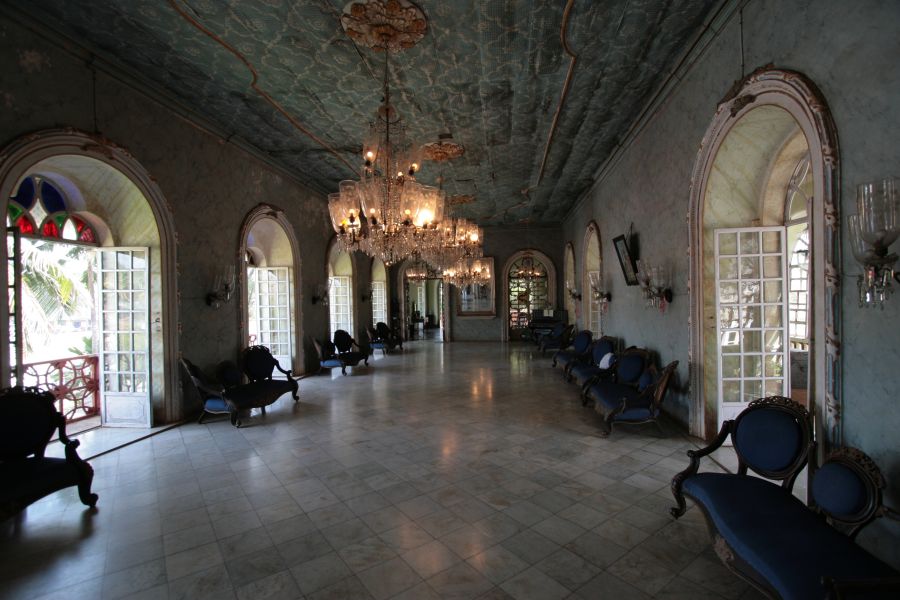
In the East end of the Braganca House, the age of the house and the ravages of time are more apparent. In the ballroom, with its Italian alabaster marble flooring and crystal chandeliers from Venice, the ceiling is damp and peeling in large chunks. But it only requires a little bit of imagination to take me back to the days when the aristocracy of old Portuguese Goa glided elegantly across the marble floor.

Today, the Braganca House serves more as a storage space for old family relics than as a memoir to the Old Portuguese way of life. In the corridor, sit a pair of ancient tombstones belonging to the Braganca ancestors. Dating back to the 1800s, they were suffering damage in the open graveyard and are now protected indoors. In the corridor also lies a palanquin, that was used by the Braganca ancestors as a common mode of transport. The family chapel also houses what is believed to be a single fingernail of the Jesuit saint and patron saint of Goa, St Francis Xavier.

The atmosphere of the Braganca House is one of saudade, the Portuguese word for a feeling of longing for something dear that is now gone. Braganca House represents the last of Goa’s golden era of prosperity.

Perhaps, some day Braganca House will come to represent the future of Goa, where tourist and locals alike will be drawn toward the heritage of Old Portuguese Goa once again…

While there is no charge for visiting the Braganca House, a donation of Rs 100 is a welcome contribution towards it’s upkeep.

Stay Romantic!

Mihir

Dona Paula Beach Goa – A tragic love story !

The Dona Paula Beach (a 10 minute drive from my Mitaroy Goa Hotel) is a pristine beach with a tragic love story to its name.

Dona Paula beach was named after the Portuguese Viceroy’s daughter Dona Paula de Menezes.

This young, innocent girl fell in love with a local Goan fisherman. Of course, this match was unacceptable to the Viceroy who forbade his daughter Dona Paula to ever see her young lover again.

Distraught with love and sorrow, Dona Paula could not bear a life without her young Goan lover and threw herself off a cliff into the unforgiving Arabian Sea.

Left with nothing but his daughter’s memory, the Portuguese Viceroy named the area Dona Paula, as an eternal tribute to his stubbornness and forbidden romance & love.

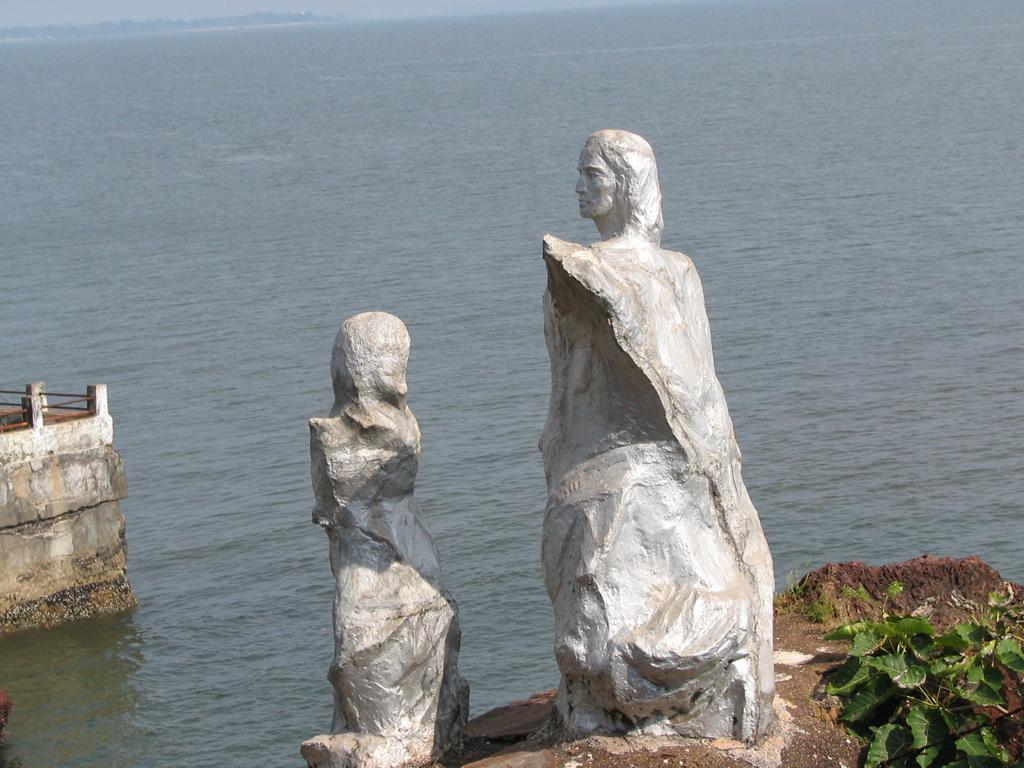
Today, there is a black stone statue of the young Dona Paula and her Goan lover on a rocky promontory jutting into the sea with a sweeping view of the Marmagoa Port in the background.

The bay of Dona Paula in Goa lies at the sangam (or meeting point) of the Arabian Sea and the Goan rivers Mandovi and Zuari. Dona Paula is located in the suburbs of the capital Panjim (where our Mitaroy Goa Hotel is located). Dona Paula is also a very fashionable residence for the rich and famous of Panjim. Originally a fishing village, Dona Paula attracts its fair share of visitors and tourists who come to marvel at its pristine beach, its natural beauty and the romantic legend associated with it.

When you are in Dona Paula, you must visit the ruins of the Cabo Fort, erected in 1540. The Cabo Raj Niwas is one of the most elegant governor’s residences in the whole of Goa.There is also a 180 year old English cemetery, open to the public along with a chapel, which has a memorial tomb of Dona Paula de Menezes with her history engraved on the tombstone.

In Dona Paula, you also have the National Oceanography Institute which was opened in 1960 to study the local Goan marine life alongwith the Marine Biology Museum. A little further (around 9 kms from Dona Paula) is the famous Salim Ali Bird Sanctuary, in the island of Choro by the side of the Mandovi river and named after the famous Indian ornithologist. The Bird Sanctuary is spread over an area of 2 sq km and is a delight for bird lovers. 10 km from Dona Paula is the famous Reis Magos church. This historical landmark is one of the oldest Churches in Goa and was dedicated to the three wise men of the East who brought the baby Jesus gifts of frankincense, gold and myrrh.

The Dona Paula beach itself is one of Goa’s best beaches for water sports such as windsurfing, water skiing, para sailing, motor boat rides etc. There are also several organised water sports facilities on offer in Dona Paula. If you do happen to get serious hunger pangs with all the water sport action, there are quite a few seafood restaurants along the stretch from Dona Paula to Miramar – including Martin’s Beach Corner, Sea Pebble, Menino’s and Sea View.

Stay Romantic!

Mihir